LATER
On the first warm night of the cool summer she wore the sarong she bought in Venice where everyone was beautiful. The fabric was soft as a sigh and brought back the surf that smelled like seaweed and the beach littered with what the ocean didn't need and the muscle volleyball game and the blackest man in America who mimed on the boardwalk. Candle wax from the last time she'd worn it had hardened in little droplets down the front. She could get it out with an iron and a piece of paper towel. But it would have to wait.
The rain came across the fields like wind through corn and what had to be done because he was gone overtook the carefree evening. She took off the sarong and hung it back in the closet, changed into jeans that fit and pulled on the tall rubber boots that didn't.
note: I was going to add one of my pictures but then decided I didn't need one. Couldn't find one that fit this little snippet of life. Couldn't find a picture of emotion, couldn't take a picture of the wind, only the effect it has on things. What am I trying to say?
Thursday, August 21, 2014
Tuesday, July 29, 2014
Hang The Garlic Over The Drive
Summer is busy but should one not always steal a moment to write? We dug our garlic and hung it in the granary. Dad said to hang it over the drive, but I didn't know what he meant. Then he told me that Grandpa used to park his car in here-there are two big sliding doors on each side of the structure-a perfect place to park your car. But it hasn't been used as a garage in my lifetime.
So I hung my garlic "over the drive" from the top railing on the third floor, climbing the steep staircase on your right. The old steamer trunk that sits behind the railing against the back wall is empty. I wonder what happened to the contents. Did I imagine them from my childhood?


and the winter squash and potatoes flourish.

A story about the granary: When we were children, an unruly cousin took our beloved red wagon to the top of those stairs and pushed it over the edge to the concrete below. The impact made a horrible noise and our wagon was smashed beyond repair. I don't think we ever got another. I don't know what compelled him to do that, but every time I climb those stairs, I remember it.
That's it for now. Off to plant more beets and lettuce. I just wanted to wake up my blog and say hello to all. How has your summer been?
So I hung my garlic "over the drive" from the top railing on the third floor, climbing the steep staircase on your right. The old steamer trunk that sits behind the railing against the back wall is empty. I wonder what happened to the contents. Did I imagine them from my childhood?
The corn that borders my garden towers overhead
and the winter squash and potatoes flourish.
That's it for now. Off to plant more beets and lettuce. I just wanted to wake up my blog and say hello to all. How has your summer been?
Monday, June 23, 2014
Bold Red Fox, Dead Red Hen
Fox have found our chicken coop and they've been taking them out in broad daylight, one by one. A neighbor alerted us to the dead chicken in their yard and fox in the driveway. Fox on the prowl. The egg count is down and now we know why. We wonder how long it's been going on, From a flock of one hundred, you could lose a few and not realize it. We close up the coop at night once the birds are all inside. They are safe at night. But daytime is killing time. Now we know.
The fox slip through the poultry fence like eels through sea grass. Nothing can stop them except a ten gauge, a keen eye and a steady finger.The loaded gun sits by the back door, though I don't like it there. We guard the poultry fence towards dusk when the chickens are still outside foraging. We watch the field, the woods, the fencerow.
We can't go to town, or down the road to dinner, can't weed the asparagus or trellis the tomatoes. Here they come across the open field, bolder than fox should be. There one goes out of range at a brisk trot with a chicken in its mouth, disappearing into the woods. Feathers on the ground. Carnage in the fencerow. Buzzards overhead, cleaning up after the fox.
We mull the fate of the birds we've raised, nurtured through winter with heat lamps to ward off the frigid wind, and now move around on open pasture, water and pamper for the eggs they give us. They are just now beginning to reach their peak egg production. All the hard work through winter was just beginning to pay off.
Wednesday, June 18, 2014
Mother And The Cutthroat
Every year mother gave me dried delphiniums (massive blooms staked against the wind swayed above the irises and poppies). She’d hang them in a dark closet along with sprigs of lavender. Once dried, they would hold their color through the winter. I have one delphinium from two years ago. Though faded in color, I save it.
One of her poppies survived the Polar Vortex. I fleshed it out of the weeds and pulled out the invasive quack grass that was smothering it. Big egg-shaped buds covered the plant, a tinge of pink at the tip promising salmon-colored crepe paper blooms in a week, or two, with sun and rain and faith. Faith was for daffodils in my grandmother’s dictionary, but the daffodils are done and the tulips are done but the poppy is to come.
But wait. The whirr of the gas-powered weed whacker warns of danger. The swoop of the handle cleaves the air, dismantling everything in its path, protective goggles and gloves for the whacker in full-throttle approach. Protection for the cutthroat but none for the poppy. In one fell unsupervised swoop, the poppy is in ruins, flecks of bud (hints of salmon) lie scattered in the grass like fluffs of dandelion.
Sister presented mother with the remnants. Poppy pieces in her lap, like rose petals saved from a prom corsage.
Friday, April 25, 2014
The Willard
 |
| Willard Asylum - Lisa Gordon |
The walls sweat
like my doctor's brow.
I long to touch dry bark,
rasp my cheek along the flank of a willow,
rest a hip against the oak
at the back of the lane.
They tell me it will make me feel better.
I swallow and nod and try
to get along.
But the walls waver and sweat
like my doctor's brow.
I can tell you how that tastes.
I want the sandy lane under my feet,
sand I can brush off and leave behind.
I wrote this poem for an artistic interpretation challenge from Margaret at the Imaginary Garden. This photo of the Willard Asylum in the Finger Lakes Region of New York was taken by Lisa Gordon when she toured the facility and photographed it. The asylum opened in 1869 and was closed in 1995. During the time it was operational, 50,000 patients called it home. Six thousand died there. Also of interest to me is Margaret's link to an ongoing project by photographer Jon Crispin called "The Willard Suitcases". He is photographing the contents of suitcases left behind by patients of the Willard Insane Asylum.
There are more photos of the asylum on Lisa Gordon's website here, including this one of a patient's grave, marked only by a number plate set in the ground.
 |
| Willard Grave Marker - Lisa Gordon |
Friday, April 11, 2014
Keeper Of The Light
 |
| Boat In The Moonlight - Odilon Redon |
No
one knows how he lost his way
on
the familiar run from
the
mouth of the river
to
his room on the quay.
The
moon was out
when
he ran aground
and the boat was found
but not the old man.
and the boat was found
but not the old man.
Only
the keeper knows
what
happened that night
how
he fell asleep
whilst tending the light.
April is poetry month, and the challenge today at The Imaginary Garden was to write an ekphrasis poem based on the work of French symbolist painter and illustrator, Odilon Redon. Ekphrasis is a literary description of a piece of art.
Wednesday, April 9, 2014
TheTurtle
I
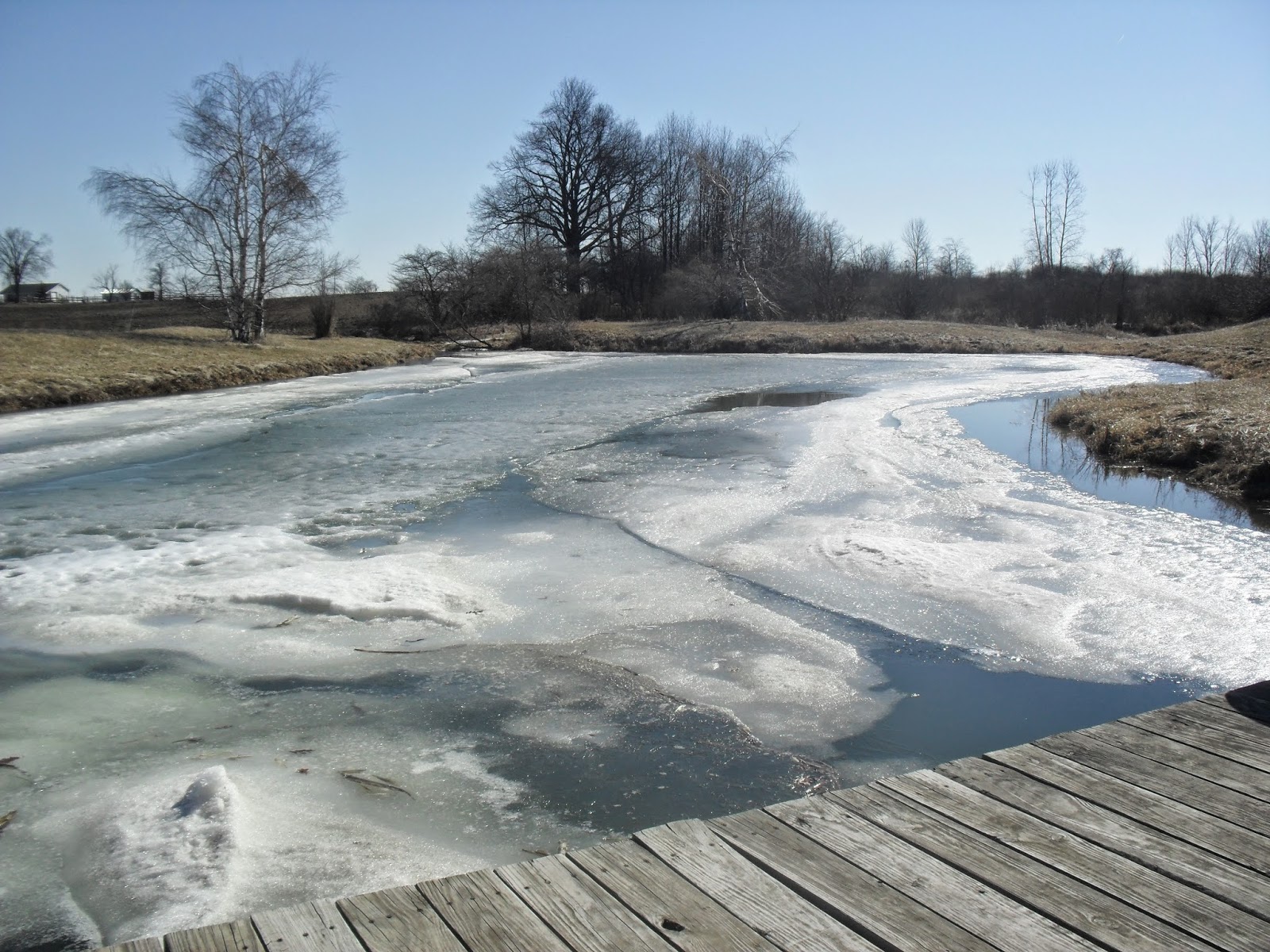
walked around the pond in search of life.
The
center is swirled in snowbanks
but the thaw has begun.
but the thaw has begun.
No floating fish-the feared winter kill-off,
only leaves and corn husks float
in the debris of spring.
only leaves and corn husks float
in the debris of spring.
Yet
under the dock, air bubbles surface
and
I imagined the turtle stirring
with
dreams of a dragonfly’s spin.
But
for now he sleeps. It’s only April.
The challenge here was to give our best and worst of April in 66 words.
Friday, April 4, 2014
Memoir/Memory
Memory is like a foggy morning: as the fog lifts, things take shape. A foggy morning pleases my writer's heart, like nature and seclusion. Upon awaking to fog, I want to light candles and brew coffee. I want it to stay like this: still and quiet.
Nothing except in things.
So, I've decided to write a memoir, triggered by a contest notice. I'd never thought I had a life others would want to read about, but as I thought this over, I decided that wasn't true and began to dig around in my head for the childhood events that stand out like signposts. As one was unveiled and examined another emerged, like trees in a fogbank.
Do you ever wonder what made you the person you are today? How you got to where you are, why some things matter to you and other don't? What your career choices have been and the people you are attracted to and the ones who repel? Writing a memoir is to take an untraveled road of discovery. And I've had the strangest, most vivid dreams of places and things and people I've not thought about in a long time. Do you wonder at the mother-lode of memory buried in our brains, waiting to be brought to light and shared?
I'm an environmentalist because my father is and my grandfather was, as was his and so on. Though they didn't call themselves that, any farmer who farms the land in a sustainable way and raises grazing animals while adhering to the time-honored practice of husbandry, is essentially an environmentalist. On road trips, Dad was constantly pointing out things of interest, from a herd of cattle to a hawk to the setting sun. He never let nature go unnoticed and while we might have been prone to day-dreaming in the backseat or squabbling about who was touching who, he drew our attention out the window to the vista in front of us or the one behind.
So that is one signpost in the road I've traveled to become the person I am today. But there are things I'm afraid to write about too, as sure as the fog will lift and the noise intrude. It takes a lot of courage to write a memoir and I commend the masters of this genre, namely Jeannette Walls who wrote The Glass Castle. And while I never led that nomadic of a life, it hasn't been one without interest and intrigue.
I've always found the idea of a "residency" intriguing. This farm might serve as my residency, except family obligations and chores always interfere. Life intrudes. That's the beauty of a true residency. Nothing intrudes between you and the writing. Dare I apply for a residency? Could I be gone for two weeks to participate in an endeavor that society places little value on? Many would see it as selfish and self-absorbed. I would see it as the gift and opportunity of a lifetime.
The closest I've ever come to a residency was a friend's summer house on a wake-free lake in Gladwin. I stayed there by myself for three days, nothing but loons, lily pads, jumping pike and grazing cattle in a field on the other side. I loved every single solitary minute. I wasn't afraid. I spread my manuscript out around the living room (itself, a luxury) and let it absorb every waking moment, stopping only to eat and sleep. In three days I edited fifty pages, wrote a poem and penned two or three sentences of another idea. Think what could be done with two weeks!
Friday, March 28, 2014
The Swan Song for Flash 55
Many a
Thursday I stayed up late
to write
a story for the man.
He liked beginnings and he liked neat ends,
so I labored long over rhythm and rhyme,
so I labored long over rhythm and rhyme,
whilst
counting my words and staying inbounds.
Other
than word count, all he asked we do
was make
it fiction, wasn't supposed to be true.
On a cold
winter morning a girl was found
frozen to
death in the snow
Nobody
knows what happened
but
speculation abounds.
Did she
slip and fall by her own accord?
Too much drink
and a lover’s row?
Would it
were summer we could sleep it off
and wake
in the arms of the morn.
After hosting
the Friday fun-fest for 7 years, Galen Hayes aka Mr. Knowitall is passing the
reins to someone else. I would encourage you to join the farewell tour.
All good
things come to an end.
Galen, you
truly are the most gracious of hosts.
I’ll miss
writing for you.
Sunday, March 16, 2014
A Black Parable
"Fiction is the great lie that tells the truth about how the world lives."
~Dorothy Allison

In Oscar Wilde's "The Picture of Dorian Gray", many universal truths are revealed between the lines of convoluted verbiage. Just as there were plodding passages I skimmed over, there were glittering sparks of dialogue and introspective pondering, which caught me by the feminine equivalent of "the balls".
I wanted to share a few of my favorite lines that made me stop and think.
~Dorothy Allison
In Oscar Wilde's "The Picture of Dorian Gray", many universal truths are revealed between the lines of convoluted verbiage. Just as there were plodding passages I skimmed over, there were glittering sparks of dialogue and introspective pondering, which caught me by the feminine equivalent of "the balls".
I wanted to share a few of my favorite lines that made me stop and think.
- "Each of us has heaven and hell in him."
- "Sin is a thing that writes itself across a man's face. It cannot be concealed. People talk sometimes of secret vices. There are no such things. If a wretched man has a vice, it shows itself in the lines of his mouth, the droop of his eyelids, the molding of his hands even."
- “To get back one’s youth, one has merely to repeat one’s follies.”
- “Nowadays most people die of a sort of creeping common sense, and discover when it is too late that the only things one never regrets are one’s mistakes.”
- “There is no such thing as a moral or an immoral book. Books are well written or badly written. That is all.”
- “He was always late on principle, his principle being that punctuality is the thief of time.”
- “The lad was premature. He was gathering his harvest while it was yet spring.”
- “No civilized man ever regrets a pleasure and no uncivilized man ever knows what a pleasure is.”
- “He had told the girl whom he had lured to love him that he was wicked, and she had laughed and answered that wicked people were always very old and very ugly. What a laugh she had!—just like a thrush singing. And how pretty she had been in her cotton dresses and large hats! She knew nothing, but she had everything that he had lost.”
Finally,
having lived half my life in the country and knowing this to be the cleverest
of ironies. my favorite is:
10. "Anyone can be good in the country; there are
no temptations there."
Though I do adhere to #6. I just had never heard it expressed so eloquently. Do you have a favorite? Have you read this novel? It sat on my shelf for fifteen years. I don't know why I put it off.
Friday, January 24, 2014
Under The Knife (Fri.Flash 55)
Would they have us melt some Tupperware
and spread it on our bread?
One molecule from plastic
should be their claim instead.
Round-up in the waves of grain
they took her breast by knife.
The deer steer clear of GMOs,
amphibians the coast.
Let’s all melt some Tupperware
and spread it on our toast.
If you like butter on your toast, let the G-Man know!
Sorry, G., I’ve
veered out of the fictional world this week into reality’s nightmare.With the
latest news I got all creepy. The brown food coloring in cola has now been
determined to be a carcinogenic. Pepsi rebuked the findings, saying even if
true, most of their customers only drink 1/3 of a can a day so amounts should be
considered safe. Does anyone know anyone who opens a can of pop and only drinks one third? And why is margarine in the dairy aisle? It isn’t even food. And it certainly isn't yellow. Margarine was “invented” and it is grayish white, the
way you’ll find it in Europe (if you find it at all), where they aren’t allowed
to dye it.
Thursday, January 9, 2014
Boomerang (Friday Flash 55)

Even as a child, she was drawn to the night
when the air was soft and fraught with life.
He, too, a child of twilight—
mysterious boy boomerang in his belt.
Was my father’s, he said,
dog circling, divining the night air.
Fingers entwined, he taught her to throw
so it would always come back.
If it's Friday, or Friday Eve, it's time for Flash, Flash 55. This weekly event is hosted by the G-Man who loves fiction with a plot and 55 words.
Tuesday, January 7, 2014
In Pursuit Of A Sparrow
This week at Poets and Writers, there's a poetry prompt to write a poem about a time the weather has affected your life. "Weather has a spiritual aspect and a profound affect on us even though it doesn't know we exist."
In the midst of this deep freeze, something called me from bed at five in the morning. Minus thirteen degrees outside, and the furance runs without pause. Why am I not still bundled in bed with a pillow over my head? Because of the poem that won't leave me alone?
It's the snow, it's the snow, deep and blowing and more
and the road is not there nor the drive nor the fields
nor silo with its rounded white globe.
Not there.
The birds have all fled to the wood and the cows
bury their noses in sweet fragrant hay.
The bull dreams of grass and the sun on his back
and the chickens fluff their feathers, heat lamps under their wings.
It came quietly in the night, like pirates boarding a ship,
blanketed the Queen Anne's Lace gone to seed in a ditch

then bestowed billows of white on the evergreen boughs
and laid down ruffles of lace up to their waist.
Silent silent.
The car lies like a behemoth under a quilt
and the bird feeders are frozen and covered with snow.
So still, so still.
But then the wind stirred on a rotational pull
and with hackles raised, set off in pursuit.
It rallied the snow, which must be put in its place,
must be molded and banked and taught to behave
and now white is the sky and the roof of the barn
and the house and the field where wheat once grew tall.
A little brown
sparrow lands on my sill,
she lands in a
candle nestled in snow.
Soft and brown
at my window, right there at my window,
this little winged
creature quivers and shakes,
under stalks
of arugula gone to seed in a vase. 
Eyes dart to and
fro, tis a mean trickery,
these stems bereft of seeds
but decked out prettily
(to us)
in white Christmas
lights.
What’s its use asks the sparrow,
so fragile yet hardy of wing and sinew
It has no seed or shelter, it’s nothing to me.
So wise, the sparrow, poised to leave. To leave.
But wait.
The Christmas
tree hauled outside on the porch—
denuded of
finery yet beautiful still—
has blown off
in the gale, but its branches
are thick
and welcoming still as on that night in the lot
when we chose it over others. All others.
Welcoming.
She flies into the
winter of my spent Christmas tree,
disappears from sight but I know she's in there.
Then joined by a
junco who was lost in the wind
a chubby little junco,
charcoal blue and lost gray.
then, look! a fat dove skitters onto the porch,
wings flutter and
clap and he joins them in there.
All so hardy and
knowing and independent of me.
Thank you for reading my long weather poem. I couldn't seem to stop. But one more thing before I go, from Book Riot, this past week comes a list of ten wonderful Kurt Vonnegut quotes. If you've stayed with me thus far, I would leave you with my favorite.
"The America I loved still exists, if not in the White House or the Supreme Court or the Senate or the House of Representatives or the media. The America I love still exists at the front desks of our public libraries."
Amen
In the midst of this deep freeze, something called me from bed at five in the morning. Minus thirteen degrees outside, and the furance runs without pause. Why am I not still bundled in bed with a pillow over my head? Because of the poem that won't leave me alone?
It's the snow, it's the snow, deep and blowing and more
and the road is not there nor the drive nor the fields
nor silo with its rounded white globe.
Not there.
The birds have all fled to the wood and the cows
bury their noses in sweet fragrant hay.
The bull dreams of grass and the sun on his back
and the chickens fluff their feathers, heat lamps under their wings.
It came quietly in the night, like pirates boarding a ship,
blanketed the Queen Anne's Lace gone to seed in a ditch
then bestowed billows of white on the evergreen boughs
and laid down ruffles of lace up to their waist.
Silent silent.
The car lies like a behemoth under a quilt
and the bird feeders are frozen and covered with snow.
So still, so still.
But then the wind stirred on a rotational pull
and with hackles raised, set off in pursuit.
It rallied the snow, which must be put in its place,
must be molded and banked and taught to behave
and now white is the sky and the roof of the barn
and the house and the field where wheat once grew tall.
Thank you for reading my long weather poem. I couldn't seem to stop. But one more thing before I go, from Book Riot, this past week comes a list of ten wonderful Kurt Vonnegut quotes. If you've stayed with me thus far, I would leave you with my favorite.
"The America I loved still exists, if not in the White House or the Supreme Court or the Senate or the House of Representatives or the media. The America I love still exists at the front desks of our public libraries."
Amen
Friday, January 3, 2014
Drinking a Dead Man's Beer (fridayflash55)
Someone poured a stein for the deceased
and set it on the mantle.
It had warmed but wasn’t flat.
The sun danced off the lake
which should have been ice-covered
but was as bare as the hands
wrapped in a rosary.
Let them wonder that you walked
amongst their grieving
and finished your final beer unfettered.
If you ever drank a dead man's beer, let the G-Man know. Write a flash piece of fiction in exactly 55 words and let the most gracious host know. Cut it up right. And have a Happy New Year!
Friday, December 27, 2013
All The Way To The Top
When the
ice storm hit on the night of the winter solstice and the power went out, we rediscovered
things we enjoy but seldom have time for, and it’s remarkable how much
time is freed up when there are no electronic devices to captivate your senses.
We paid close attention to daylight hours and the sun’s position in the sky; we minded time by the path of its progression. At nightfall, we lit candles and hauled an old kerosene heater out of the attic and kept track of the matches. We played cards and dominoes by candlelight. With the television off and internet down, the piano regained its rightful place at center stage, and rusty fingers turned nimble over the course of the outage.
When the skies cleared and the sun came out, the kids took to the outdoors with boots and camera. They climbed the slide on the dock at the pond,
 all the way to the top.

And saw the tracks leading across the ice.
We paid close attention to daylight hours and the sun’s position in the sky; we minded time by the path of its progression. At nightfall, we lit candles and hauled an old kerosene heater out of the attic and kept track of the matches. We played cards and dominoes by candlelight. With the television off and internet down, the piano regained its rightful place at center stage, and rusty fingers turned nimble over the course of the outage.
When the skies cleared and the sun came out, the kids took to the outdoors with boots and camera. They climbed the slide on the dock at the pond,


And saw the tracks leading across the ice.
But I, wrapped in sweaters and scarves, read the first few chapters of hard copy, changed a few good words for better words and found errors that I missed on the screen. I call it monitor blindness.
I considered a story of mayhem and murder in a two-hundred-year old barn. You can research a novel in a spooky barn, but do it before the sun goes down.

Just saying…it’s not all bad when the power goes off. And when it comes back on, you have another experience to write about.
I considered a story of mayhem and murder in a two-hundred-year old barn. You can research a novel in a spooky barn, but do it before the sun goes down.

Just saying…it’s not all bad when the power goes off. And when it comes back on, you have another experience to write about.
Friday, December 6, 2013
The Ghost of Red Rover (Friday Flash 55)
The girl's locked in the outhouse,
a boy climbs a tree.
Hiding in the brambles,
two maybe three.
Merry-go-round twirls,
ribbons in her hair,
teeter-totter trembles
with a weight that isn't there.
A wistful wind whistles
through the lilac hiding place,
telling of those who huddled there
when they were young and scared.
This is a Friday Flash 55 for the G-Man. If you write a flash piece on Friday, let him know. This is written in rememberance of playgrounds with steel slides and wooden teeter-totters. Playgrounds that were a refuge and a curse, playgrounds that instilled bravery when we were young and scared.
Saturday, November 30, 2013
Self-Service (Fri. flash 55)
The man's stump
hangs at his side like a tuber.
He pushes his cart
and stands in line.
The stump is hairy, like an old man's ear.
I watch my mother
struggle from walker to bed,
the laborious lifting of a leg,
the settling in.
The collective exhale
when she opens her eyes
and smiles.
Written belatedly for the host of Friday Flash 55. Here's to hearth and home and lingering at the table. Have a good weekend.
Tuesday, November 26, 2013
Elmore Leonard on the Mortal Sin of Dialogue Tags
Elmore Leonard needs no introduction but his rules of writing bear repeat. I particularly like Rules 3 and 4 and need to be constantly reminded of 3 and 4. So I'm herein reminding myself at the same time I'm reminding you.
Elmore Leonard’s rules of writing.
Rule 3. Never use a verb other than“said” to carry dialogue. The line of dialogue belongs to the character; the verb is the writer sticking his nose in. But said is far less intrusive than grumbled, gasped, cautioned, lied.
Rule 4. Never use an adverb to modify the verb “said” . . .he admonished gravely. To use an adverb this way (or almost any way) is a mortal sin. The writer is now exposing himself in earnest, using a word that distracts and can interrupt the rhythm of the exchange.
It’s better to convey your characters emotion through their actions, odd habits (ie. biting bottom lip, etc.) and that the word 'said' disappears to readers
Despite the overwhelming temptation to do otherwise, use the word, “said,” a lot. The classic dialogue tags,“He grimaced,” or “He chuckled,” or “He snickered” draws attention to the tag line and away from the purpose of the dialogue. Use them sparingly.
If you feel the snickering or chuckling is necessary to move your story forward, fine. Just put it in a sentence of its own.
“No, you don’t,” he chuckled.
vs.
“No, you don’t.” He chuckled at the notion.
Turn your inappropriate tags into enhancing sentences to improve your writing.
Finally: Don't let your characters sound the same.
I know I shouldn't stick my nose in a character's line of dialogue, but like any mere mortal writer, I often buckle to the temptation. How about you? Are you guilty?
Tuesday, November 19, 2013
Make A Green Gesture
When we think of carbon emissions, we think of coal plants and motor vehicles, but the truth is, computer and internet usage are emissions culprits as well. I participated in the original German Carbon Neutral Blog Campaign several years ago. It was so successful, they are now doing an American launch. The Green Gestures campaign is a large-scale reforestation initiative here in the U.S., by bloggers, for bloggers, in collaboration with the Arbor Day Foundation. Participation is easy and free, and a native tree will be planted for your blog in an American forest to double the positive impact your efforts will have on the environment.
On the Make A Green Gestures site (the sister campaign to Make It Green) there are links to easy steps we can all take to help out, like ways to opt out of junk mail (phone books) and all that paper, and ideas for avoiding petroleum based products.
If you want to participate, all you have to do is write a short post about the campaign and link to the Green Gestures site. Email them with the url of your post and they will plant a tree for your blog.
 Because we can never have too many trees. Thanks for reading and participating. Have a Green day!!
On the Make A Green Gestures site (the sister campaign to Make It Green) there are links to easy steps we can all take to help out, like ways to opt out of junk mail (phone books) and all that paper, and ideas for avoiding petroleum based products.
If you want to participate, all you have to do is write a short post about the campaign and link to the Green Gestures site. Email them with the url of your post and they will plant a tree for your blog.
Friday, November 8, 2013
Death Of A Writer (friday flash 55)
The writer's cabin
built atop a dune
was supposed to inspire
the writer.
Now it is empty of the writer.
Only clutter
that doesn’t belong
to a writer
remains.
The wind reshapes the dune.
The dune grass bows to the wind.
Its roots hold the dune in place
but the writer was not to stay.
If it's Friday, it's Flash 55, (a short in exactly 55 words). If you want to read more, or if you've written one yourself, go here.
Don't worry, be happy. It's Friday.
TGIF
Subscribe to:
Posts (Atom)